Yard drainage and French drain installation in Canandaigua
Standing water in the yard, a wet basement wall every April, a driveway that turns into a creek — drainage is the fix, and it's a dirt job.
Water problems in Ontario County almost always come down to clay. Our soils drain slowly, the water table rides high in spring, and any low spot in a lawn becomes a pond that stays until June. The same water pushing against a foundation wall shows up as a damp basement, efflorescence, or a sump pump that never shuts off.
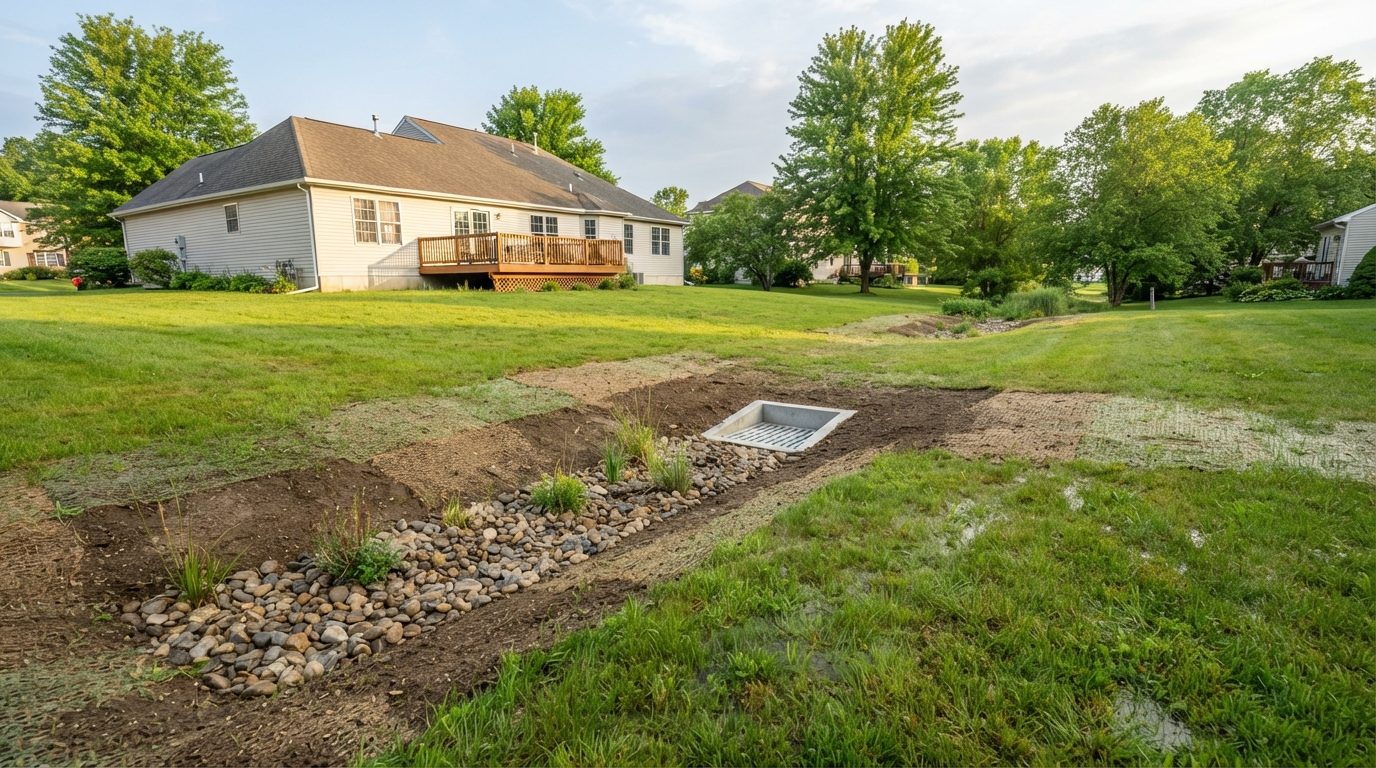
We solve drainage problems with the tools that actually move water: French drains and curtain drains to intercept it, catch basins and yard drains to collect it, solid pipe to carry it, and regrading to make sure the surface sends it the right way in the first place. Every system we install ends somewhere real — a daylight outlet on a slope, a dry well sized for the flow, or a municipal storm connection where one exists.
We don't do interior basement waterproofing. If your problem is a cracked wall or a failed footing drain, we can dig it and fix the outside, and we'll tell you honestly when the answer is a waterproofing contractor instead of us.
What's included
- French drains and curtain drainsPerforated pipe in a fabric-wrapped stone trench, set to grade, intercepting groundwater before it reaches the house or the low spot.
- Foundation drain excavationDigging down to the footing, replacing failed or crushed drain tile, and backfilling with stone so the wall stays dry.
- Catch basins and yard drainsCollecting surface water in the spot where it ponds and piping it away underground.
- Downspout and sump discharge linesGetting roof and sump water 20, 50, or 100 feet from the foundation instead of dumping it at the wall.
- Dry wellsSized to the roof area or flow they need to take, set in the best-draining soil we can find on the lot.
- Swales and regradingReshaping the surface so water leaves the yard on its own, often the cheapest fix of all.
Why yards flood between Canandaigua and Rochester
Subdivisions built on former farmland in Farmington, Victor, and Henrietta sit on the same clay the farmers fought. Builders strip the topsoil, compact the subgrade with machines, and put a few inches of topsoil back over it. The result is a lawn that looks fine but drains like a parking lot. A curtain drain across the uphill side of the yard, tied to a daylight outlet or a dry well, usually cures it.
Older homes in the city of Canandaigua, Geneva, and the villages have a different issue — clay footing tile from the 1940s through the 70s that has crushed, silted up, or was never connected to anything. If the basement gets wet only during heavy rain or snowmelt and the water comes in at the floor-wall joint, the footing drain has likely failed. Excavating and replacing it from outside is the permanent fix.
Lakefront lots get it from both directions: groundwater moving downhill toward the lake, and lake-effect storms that drop an inch of rain in an hour. Those sites need drains that intercept the hillside flow above the house and controlled outlets that don't erode the bank. The watershed council cares about that last part, and so do we.
What moves the price
- Linear feet of drain and how deep it needs to be to get below the water problem.
- Where the water can go. A gravity outlet to daylight is cheapest; a dry well or pumped system costs more.
- Access for the mini excavator versus hand-digging near foundations, utilities, and mature trees.
- Stone and fabric quantities — a proper French drain uses more clean stone than people expect.
- Restoration: topsoil and seed, or sod if you want the lawn back immediately.
Drainage & French Drains: questions we get
How much does a French drain cost in the Finger Lakes?
A typical residential French drain runs by the linear foot, with total jobs commonly landing in the low-to-mid thousands depending on length, depth, and outlet. Our drainage cost guide walks through the ranges.
Will a French drain fix my wet basement?
If water is entering because the ground around the foundation stays saturated, an exterior French drain or replaced footing drain usually solves it. If water is coming through cracks under hydrostatic pressure, or the floor slab is below the water table, you may need a waterproofing contractor as well. We'll look at it and tell you straight.
Where does the water go?
The best answer is downhill to daylight — an outlet on a slope where the pipe pops out and water runs away on the surface. On flat lots we use a dry well or, where the town allows it, a storm sewer connection. We never route water onto a neighbor's property.
How deep should a French drain be?
Deep enough to get below the level where water is causing the problem. Around a foundation that means the footing. In a yard it's often 18 to 30 inches. The pipe needs consistent fall — about 1% minimum — the whole way to the outlet.
Can you fix drainage in the winter?
Emergency work, sometimes. But drain trenches need to be set to precise grade and frozen ground fights that. Late fall and early spring are the best times, and you'll see whether it worked when the snow melts.
Drainage across the Finger Lakes
We do drainage & french drains in every town below. Pick yours for the local details.
Ontario County
- Canandaigua
- Victor
- Farmington
- Bristol & South Bristol
- Naples
- Gorham
- Hopewell
- Manchester & Shortsville
- Clifton Springs
- Phelps
- Honeoye & Richmond
- East Bloomfield
- West Bloomfield
Finger Lakes
- Geneva
- Penn Yan & Keuka Lake
- Middlesex & Vine Valley
- Rushville & Potter
- Seneca Falls & Waterloo
- Lima & Livonia
Rochester Area
Syracuse Area
Get a quote
Call, or send the form and we'll get back to you — usually the same business day. Tell us the town and what you're trying to do; a photo or two never hurts.
(585) 575-0567Serving Canandaigua, Ontario County, the Finger Lakes, and the Rochester area. Larger Syracuse-area projects by arrangement.