Septic system excavation and installation in the Finger Lakes
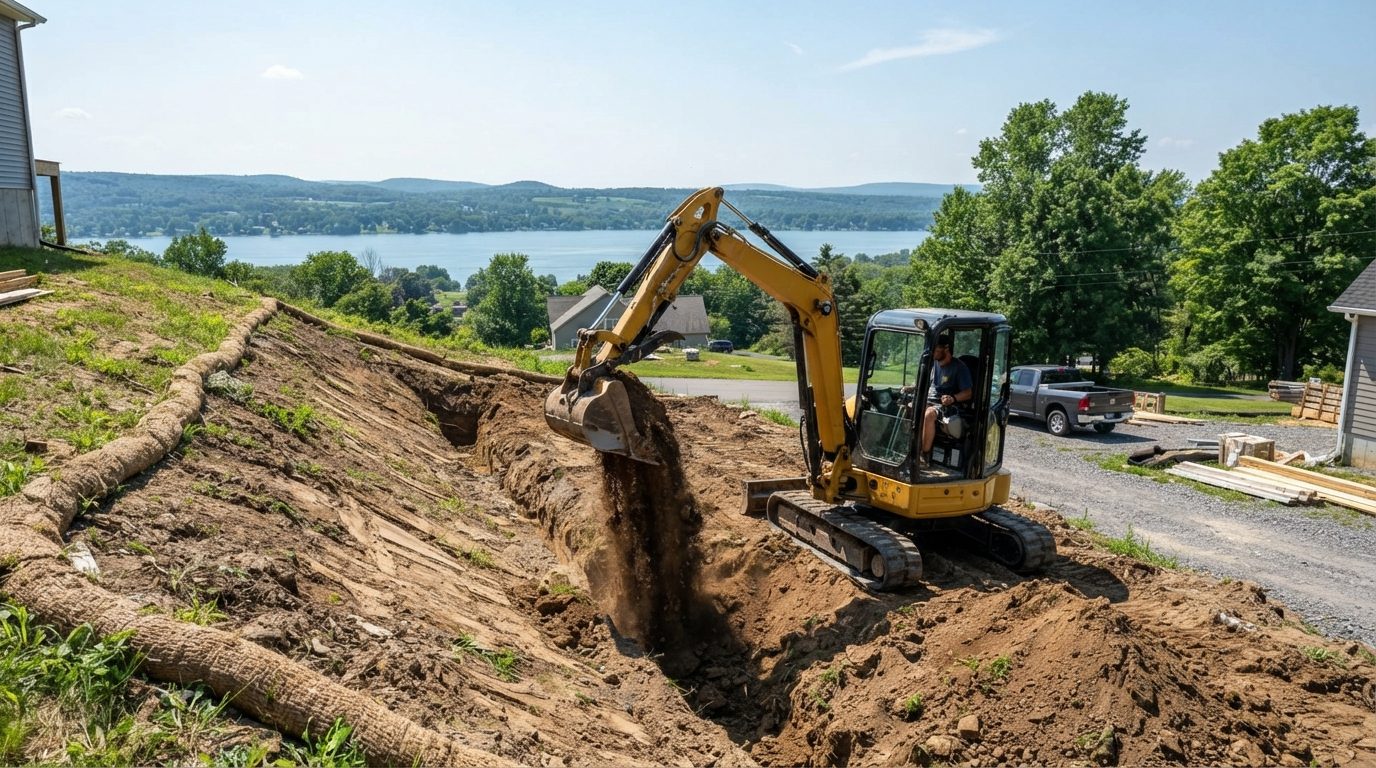
New systems on rural lots, failed leach fields replaced, tanks set and connected — done to the engineer's design and the county's approval.
Most of Ontario County outside the city and villages is on septic. Every farmhouse in Gorham, every lake cottage in Middlesex, every new build on a five-acre lot in Bristol depends on a tank and a leach field working quietly in the yard. When they stop working quietly, it's an excavation job.
We install complete conventional systems — tank, distribution box, and absorption trenches or beds — and the raised and alternative systems that tight lots and slow soils sometimes require. We also replace failed leach fields, set new tanks when old steel or concrete ones give out, and dig and repair the sewer line between the house and the tank.
Septic in New York runs through the county health department. The design has to be done or approved by a licensed engineer or the department, the soil has to be tested, and the installation gets inspected before it's covered. We work inside that process every week and we'll walk you through it.
What's included
- New septic system installationTank, distribution box, and leach field built to the approved design, inspected before backfill.
- Leach field replacementRemoving a failed absorption area and building a new one, often in a fresh location on the lot.
- Tank replacementPulling a rusted steel or cracked concrete tank and setting a new precast or poly tank.
- Raised and fill systemsFor lots with shallow bedrock, high groundwater, or slow clay — common near the lake.
- Sewer line repairExcavating and replacing the pipe between house and tank, or tank and field.
- Perc tests and deep hole testsDigging the test pits the health department needs for a new system design.
Septic in Ontario County: clay, slope, and the health department
The soils that make farming good here make septic hard. Heavy clay percs slowly, and a lot of lots between Canandaigua and Geneva fail a standard perc test outright. That doesn't mean you can't build — it means the design will call for a larger absorption area, a raised bed, or an alternative system, and the excavation gets bigger accordingly.
Lakefront lots have their own math. Setbacks from the lake, from wells, and from property lines shrink the usable area, and steep grades push designs toward pumped or raised systems. The watershed council and the towns around Canandaigua Lake are strict about it, and for good reason. If you're buying a lake property with an older system, get it inspected before closing — replacing one on a tight shore lot is a serious project.
For repairs, the failures we see most are old steel tanks that have rusted through, leach fields that have biomat-sealed after 30 or 40 years, and distribution boxes that have shifted so one trench takes everything. Each one has a different fix, and none of them are solved by pumping the tank more often.
What moves the price
- System type. Conventional trenches are least expensive; raised beds and alternative systems cost more.
- Soil and perc results, which drive the size of the absorption area.
- Tank size and material.
- Site access and how much of the yard has to be restored.
- Engineering and permit fees through the county health department.
Septic System Excavation: questions we get
How much does a septic system cost in Ontario County?
A conventional system on a lot with decent soils is typically in the low five figures installed. Raised beds and engineered alternative systems for clay or lakefront lots run higher. Design and permit fees are separate. Call for a site-specific number.
Who designs the septic system?
In New York the design comes from a licensed professional engineer or, for some simple replacements, the county health department. We work from the approved plan and coordinate the inspection. If you don't have an engineer yet we can point you to ones who work in Ontario, Yates, and Livingston counties.
How do I know if my leach field has failed?
Soggy or unusually green patches over the field, sewage odors outside, slow drains throughout the house, or backup after heavy use. A tank that fills right back up after pumping is the clearest sign — the field isn't taking water.
Can you install a septic system on a steep lake lot?
Often yes, with a pumped or raised design that meets the setbacks. Some lots are genuinely too small or too steep for a compliant system, and the health department will tell you so during design. We'd rather you know before you buy the lot.
How long does a septic install take?
The excavation and installation is usually two to four days for a conventional system. Design, soil testing, and permit approval before that can take several weeks, so start early if you're on a construction schedule.
Septic across the Finger Lakes
We do septic system excavation in every town below. Pick yours for the local details.
Ontario County
- Canandaigua
- Victor
- Farmington
- Bristol & South Bristol
- Naples
- Gorham
- Hopewell
- Manchester & Shortsville
- Clifton Springs
- Phelps
- Honeoye & Richmond
- East Bloomfield
- West Bloomfield
Finger Lakes
- Geneva
- Penn Yan & Keuka Lake
- Middlesex & Vine Valley
- Rushville & Potter
- Seneca Falls & Waterloo
- Lima & Livonia
Rochester Area
Syracuse Area
Get a quote
Call, or send the form and we'll get back to you — usually the same business day. Tell us the town and what you're trying to do; a photo or two never hurts.
(585) 575-0567Serving Canandaigua, Ontario County, the Finger Lakes, and the Rochester area. Larger Syracuse-area projects by arrangement.