Foundation and basement excavation in Canandaigua
New homes, additions, garages, and pole barns — dug to the engineer's depth, graded to the laser, backfilled so it never settles.
Digging a foundation is the one part of a build where being off by a few inches costs real money. Too shallow and the footing sits above frost. Too deep and you're paying for extra concrete or engineered fill. Out of square and the foundation crew loses a day. We dig to the plan and we check it with a rotary laser before the forms go up.
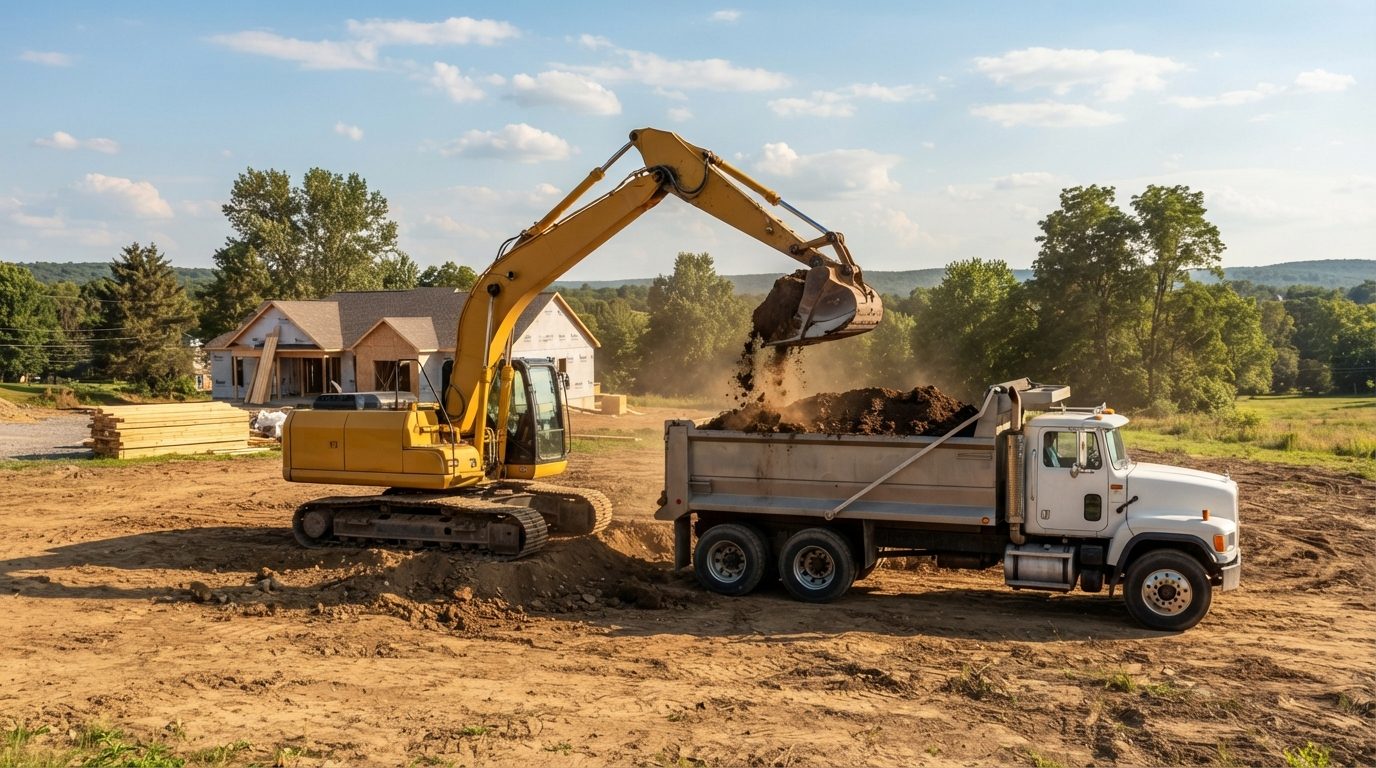
We work directly with homeowners, with builders, and with foundation contractors who want a reliable dig on the schedule. On a typical new-home lot we strip and stockpile topsoil, excavate the basement or crawlspace to the engineered depth with the overdig the foundation crew needs, cut footing trenches, and leave a clean, level, drained hole. After the walls are poured and damp-proofed we come back for footing drains, stone, and backfill in compacted lifts.
Additions and garages follow the same logic on a smaller scale, with the added challenge of working next to an existing foundation without undermining it.
What's included
- Basement and crawlspace excavationFull dig to the engineered depth with proper overdig for forms and drainage.
- Footing trenchesCut to width and depth for the footing design, below the 42-to-48-inch frost line.
- Slab and pad prepGarages, pole barns, and slab-on-grade homes: cut to grade, compacted stone base, ready for forms.
- Addition excavationCareful work alongside an existing foundation, including shoring where needed.
- Footing drains and stonePerforated drain tile, filter fabric, and washed stone around the footing before backfill.
- Backfill and rough gradeBackfill in lifts with the right material, then rough grading to drain away from the house.
Digging foundations in Ontario County soil
Our glacial till is generally good to bear on — dense and stable once you're below the topsoil and the frost zone. The surprises come in two forms. The first is shallow shale bedrock, common in Bristol, South Bristol, and along the lake's east side, which turns a two-day dig into a four-day one with a hydraulic breaker. The second is soft, saturated clay in low-lying areas of Farmington, Manchester, and the flats north of Canandaigua, where the footing design may call for extra depth or a stone bearing layer.
We recommend a soils look before we quote a new-home basement — a test pit with the excavator, an hour of your time, and it removes most of the guesswork about rock and groundwater. If the water table is high, we'll talk about whether a full basement is worth it or whether a crawlspace or slab makes more sense on that lot.
Frost is the other constant. Footings in this part of New York have to be at least 42 inches below finished grade, and most engineers spec 48. We dig to the plan, but if the plan says 36 inches, we're going to ask about it.
What moves the price
- Size and depth: a full basement moves a lot more material than a crawlspace or slab.
- Rock and groundwater. A test pit before quoting is worth it.
- Access and where the spoils go — stockpiled on site for backfill or hauled off.
- Footing drains, stone, and damp-proofing coordination with the foundation crew.
- Season and weather; we won't backfill into a hole full of water.
Foundation & Basement Excavation: questions we get
How much does it cost to excavate a basement?
It depends on the footprint, depth, soil, and how much material has to leave the site. Most residential basement digs in our area fall in the mid-to-high four figures for the dig itself, with backfill and footing drains priced separately. Our excavation cost guide has typical ranges.
How deep do footings need to be in New York?
Below frost, which in Ontario County means at least 42 inches from finished grade, and 48 is common in engineered plans. Your building department and engineer set the number; we dig to it.
Do you work with my builder or foundation contractor?
Yes. Most of our foundation work is coordinated with a builder or a poured-wall contractor. We show up when they need the hole and come back when they need the backfill.
What if you hit rock?
We stop, look at it, and talk to you. Sometimes it's a boulder we can pop out. Sometimes it's shale bedrock that needs a breaker, which is priced hourly. A test pit beforehand usually tells us what to expect.
Can you dig a foundation in winter?
We can, with frost ripping and more time, but it's rarely worth it for a homeowner. Foundations poured on properly prepared ground in April will be ready for framing sooner than a fight with frozen clay in January.
Foundations across the Finger Lakes
We do foundation & basement excavation in every town below. Pick yours for the local details.
Ontario County
- Canandaigua
- Victor
- Farmington
- Bristol & South Bristol
- Naples
- Gorham
- Hopewell
- Manchester & Shortsville
- Clifton Springs
- Phelps
- Honeoye & Richmond
- East Bloomfield
- West Bloomfield
Finger Lakes
- Geneva
- Penn Yan & Keuka Lake
- Middlesex & Vine Valley
- Rushville & Potter
- Seneca Falls & Waterloo
- Lima & Livonia
Rochester Area
Syracuse Area
Get a quote
Call, or send the form and we'll get back to you — usually the same business day. Tell us the town and what you're trying to do; a photo or two never hurts.
(585) 575-0567Serving Canandaigua, Ontario County, the Finger Lakes, and the Rochester area. Larger Syracuse-area projects by arrangement.